Remove the Screws and Build Anew

By Chris Moldes

Normalization of relations with other countries is a basic tenet of any left foreign policy for the United States. So too is the idea that climate change poses one of the greatest risks to the planet and unconditional international cooperation will be required to mitigate the damage.  The first is essential if the second is to succeed. Only by fully recognizing and entering into dialogue on equal footing can any further, more transformational policies be open to discussion. Though there are many policy prescriptions regarding these two points, the United States does not have to look far to find a prime example of putting both into practice: Cuba. After the brief honeymoon period following Barack Obama’s 2015 resumption of official diplomatic ties, US-Cuban relations are once again souring. But the upcoming leadership transition means presidential power will soon pass from the Castro family for the first time since the Cuban Revolution. This is a unique opportunity for the United States to demonstrate not only its willingness to accept historical reality by completely normalizing relations, ending the embargo, and closing the base in Guantanamo, but also its commitment to fighting the effects of climate change.
Continue reading “Remove the Screws and Build Anew”

Disaster by Design

By Jeb Boone

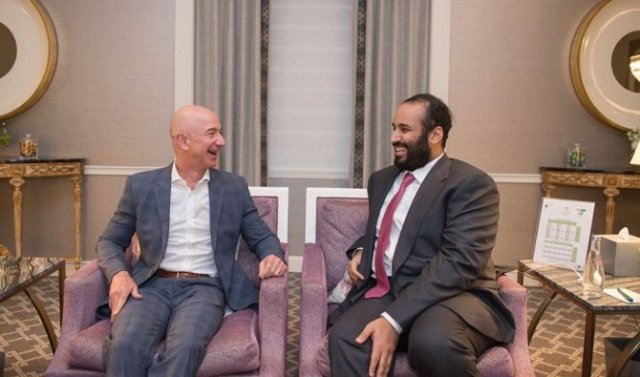
Saudi Arabia’s Crown Prince Mohammad bin Salman (MbS) was the toast of boardrooms and newsrooms alike in his recent visit to the United States. Billionaires Jeff Bezos and Bill Gates were happy to stooge for the monarch in candid, jolly photo ops.

1144486-1858336357
Billionaire Jeff Bezos with MbS (Saudi Press Agency)

Those photos are a perfect representation of the US-Saudi relationship when it comes to Yemen – billionaires cheerfully posing for professional photos while thousands starve.

Senators Bernie Sanders and Mike Lee recently sponsored a bill that would have ended US involvement in the brutal, Saudi-led and US supported imperialist war in Yemen but the legislation didn’t even come up for a vote. Ten Democrats, including recently elected Alabama #resistance hero Doug Jones, flocked to the side of their Republican colleagues to table the bill.

While US lawmakers continue to “resist” the Trump administration through acquiescence, Yemenis – already some of the world’s most impoverished, food insecure people – face US bombs dropped by Saudi pilots, Houthi ordnance, cholera, famine and mass death.   

Who is responsible for what the UN now calls the world’s worst humanitarian crisis?

Continue reading “Disaster by Design”

We Need a Smarter Conversation About Russiagate

By David Klion

Any honest observer of Donald Trump’s 2016 campaign could see that it had suspicious ties to Russia, and anyone who followed U.S.-Russia relations prior to 2016 should have known that the allegations of Russian interference were plausible. A strain of denialism about this on the left has only gradually abated as more evidence has emerged, but a tendency to dismiss the story as overblown persists, motivated to a large extent by contempt for the Russiagate-obsessed liberal and centrist “Resistance.” And much of that contempt is deserved; the popular narrative that nefarious Russians subverted the otherwise pure American Republic is wishful thinking. Russian interference was real and significant, but it only worked because something had gone terribly wrong with U.S. political institutions.

Continue reading “We Need a Smarter Conversation About Russiagate”

Make Aggression a Crime Again

By Michael Youhana

Last week, Sinan Antoon published a reflection on the fifteenth anniversary of the invasion of Iraq in The New York Times. An emergent antiwar left would do well to contemplate his essay in its entirety. One line, in particular, struck me:

“The invasion of Iraq is often spoken of in the United States as a ‘blunder,’ or even a ‘colossal mistake.’ It was a crime.”

Zahra Ali, Matt Taibbi, and even Jill Stein made similar statements on the solemn anniversary. Much of the American left seems to agree on this point.

But was the invasion of Iraq actually a crime? Kirk H. Sowell, a meticulous analyst of Iraq’s domestic politics, doesn’t think so. He argues that such accusations are little more than petty slogans:

“The use of the term “crime” is mindless. No evidence of a crime is put forward; Iraq in fact violated the armistice, which followed the 1991. And a “crime” requires a mental state. Bush’s ignorance was historic, but the evidence is clear he sincerely believed the WMD rhetoric.”

I disagree with Sowell. While I don’t think that there’s anything wrong with sloganeering for a good cause, doing so is not necessary here. The Iraq War was a crime. And the war was criminal whether or not President Bush was genuinely concerned about the proliferation of weapons of mass destruction. It was criminal for the simple reason that the war’s architects violated the well-established international prohibition against waging a war of aggression.

Continue reading “Make Aggression a Crime Again”

Fifteen Years of Blood

This week is the fifteenth anniversary of the beginning of the Iraq War, an illegal intervention that continues to immiserate millions. The war is a moral wrong and a criminal act, which condemned the war and its proponents long before the first munitions claimed their first victims. By the time the consequences of the war unfolded, they should have been damned irrevocably. The hideous fruits of the Iraq War – the human suffering, the interminable and metastasizing violence, the wanton squandering of wealth, corruption, outright looting, the hundreds of thousands or more Iraqi and over 4800 coalition dead before the initial 2011 withdrawal – are not the product of some unforeseen twist of fate. They fell well within the predictions and warnings of its opponents, offered openly at the time.

Yet within the conventional wisdom of the Washington national security establishment, to have aligned yourself with the most stridently anti-war voices in 2002 and 2003 remains a similar or greater discredit to your character and continued professional suitability than having planned or advocated the war itself. Too many of the policymakers who pushed for or voted for the Iraq War remain not only in office or positions of influence, but relied upon as key figures in national security legislation. Too many of the supposed experts who ginned up the Iraqi threat and bungled the war’s execution remain trusted fonts of strategic wisdom. Too many of the journalists and commentators who pushed dubious information and waged a propaganda campaign against the war’s opponents remain trusted voices in today’s debates. Until there is accountability suitable for the magnitude of the wrong, there is little chance of an authentically left policy, or any firm departure from the miserable Washington national security consensus, successfully breaking free of malign institutions and their tired dogmas.

Continue reading “Fifteen Years of Blood”

The Skripal Poisonings and the Chance To Build A Left Foreign Policy

Jeremy Corbyn, leader of the Labour Party, has been one of the prime movers in exposing the corrupting influence of foreign money and Britain’s complicity in Russian crimes. His response to Tory PM Theresa May, (and even his more measured comments today) however, shows the limits of Corbyn’s foreign policy prowess as well as the general unease left politicians still have have in dealing with the confluence of international relations and finance. Indeed by using the tools of financial sanctions against the corrupt and the dangerous, we can create a more equitable society while punishing Putin and his allies where they will feel it the most.

Theresa May announced this week that the UK would expel 23 Russian diplomats, identified as “undeclared intelligence officers” after the attempted poisoning of former Russian spy Sergei Skripal and his daughter Yulia Skripal in Salisbury. Provided after an ultimatum that drew only mocking and sarcasm from Russia’s foreign ministry, May went so far as to declare the use of the nerve agent Novichok (a weapon developed by the USSR in the 1970s and 80s) an “unlawful use of force.” Among other measures, May also announced that the UK would be increasing customs checks for private flights originating from Russia as well as a variety of other more pro forma measures. Continue reading “The Skripal Poisonings and the Chance To Build A Left Foreign Policy”

A Case for Transitional Justice

By Emma Steiner

The Trump administration has dissected, denounced, decried and dissolved many of the Obama administration’s actions. That the current president is so set on undoing his predecessor’s accomplishments should not keep those on the left from evaluating the Obama administration as well, especially through the lens of inaction. Why were no top-level bankers prosecuted for their role in the financial crisis of 2008? Why have so few Bush-era officials had to answer for their crimes, ranging from “enhanced interrogation” to the Iraq invasion? When bringing up Obama’s inaction, the standard response is: what else could be done? What would you have done? It is becoming clear that much more could have been done if not for the Obama administration’s lack of political will and optimistic desire to break continuity with the practices of the past. If sunlight is the best disinfectant, a failure to apply it leaves a festering wound, with complications that continue to amass.

In 2009, Obama was asked whether he would appoint a special prosecutor to investigate and potentially act against Bush officials who had committed crimes. He did not rule out the possibility, but said that his intention was to “look forward.” Very little action was taken until, in the wake of the 2014 torture report, Obama admitted, “We tortured some folks,” and his DOJ issued some memos denouncing extrajudicial interrogation. That was the full extent of action taken, and Obama’s administration went on to commit its own human rights abuses, ranging from escalation of drone warfare to full-scale NSA surveillance on Americans. Afraid of appearing partisan, the Obama administration looked the other way when it came to prosecuting war criminals and torturers. The lack of confrontation is coming back to haunt us.

Continue reading “A Case for Transitional Justice”