Policy from the People, Part 1

By Caleb Weaver

This is the first of a two-part series on foreign policy development in social movements. Part One lays out the case for social movements as the natural home for left foreign policymaking, and Part Two traces the history of foreign policy development in the American labor movement since the end of the Cold War.

For socialists, one of the most frustrating aspects of United States foreign policy is the ease with which think tanks influence the policy process despite their lack of popular support, grassroots presence, or even a particularly broad audience. Both the avowed right wing and the so-called center turn funding from capitalists into a steady stream of studies, reports, and white papers with conclusions that too often align with the material interests of their funders. As the need to develop and implement left-wing foreign policy becomes more apparent, a temptation has emerged to recreate this policy method by cultivating  our own set of foreign policy think tanks to wage ideological battle against the “experts” and “fact-checkers.”

Zack Beauchamp’s 2017 piece in Vox (referring to progressives in general, rather than specifically the socialist left) encapsulates the argument that the lack of countervailing think tanks is to blame for the right wing’s domination of the foreign policy discourse. More recently,  the thinking goes that “left wing foreign policy institutions” will improve foreign policy here and now by arming existing left-of-center politicians with actionable proposals while also incubating the foreign policy ideas that a future leftist movement will need to win support and wield power. The rush to establish institutions, however, overlooks the role that social forces must play in developing all aspects of a socialist program, foreign policy included. Formulating the left’s foreign policy at the elite level can only result (and has resulted before) in policies that are unacceptable for committed socialists. The need to root the left’s foreign policy in social movements stems from three observations.
Continue reading “Policy from the People, Part 1”

Upending the Orientalist Logic of “Honor Killings”

“Honor killings” figure prominently in portrayals of majority-Muslim countries as barbaric threats to Western culture. Islamophobic politiciansincluding President Trump in his Muslim ban executive orderpresent murders of women by male family members for perceived sexual indiscretions as a timeless characteristic of Muslim culture and law. Molly Bangs, a Senior Associate at The Century Foundation, has a new report out that flips the orientalist logic of the “honor killings” narrative on its head, demonstrating that laws protecting men who kill women whose sexual choices they disapprove of are widespread in the West and arrived in the Middle East through colonialism rather than the institution of religious law. I spoke with Molly over email to discuss her report and its implications for how we think about gender-based violence as a foreign policy issue.

Sam Ratner: I think the best place to start is with how you came to the topic and what the conventional wisdom is regarding so-called “honor killings.” What made you dig into gender-based killings in the US and Muslim-majority countries, and how would you describe the policymaking community’s current understanding of the problem?

Molly Bangs: When Dr. Alanoud Alsharekh came to The Century Foundation to discuss her work on gender-based killings in Kuwait and spoke of the legal codifications of such practices in the country’s penal code as remnants of colonialism, some of my coworkers and I got to talking about comparisons that could be drawn between Kuwait, other countries in the Middle East, and our own United States. The policymaking community, to my knowledge, has not previously focused on “honor killings” as being an issue in the US (except when the killer is a Muslim immigrant), instead separating such murders from the pervasive cases of intimate partner violence resulting in death at the hands of non-immigrant Americans. So recognizing the orientalist choices of labels for these murders on the basis of who the perpetrators are, I started to analyze the colonial roots of the Kuwaiti and American legal systems (and their sequential development), and found many similarities deriving from British Common Law and the French Penal Code in terms of men’s ownership of women and presenting the murder of women in cases of adultery as excusable and less than first-degree murder.

Continue reading “Upending the Orientalist Logic of “Honor Killings””

Down with the demos! Long live democracy!

A review of Daniel Bessner’s Democracy in Exile: Hans Speier and the Rise of the Defense Intellectual (Cornell University Press, 2018).

By Jasmine Chorley

In his December 1939 essay “The Jews and Europe,” German critical philosopher Max Horkheimer pilloried a certain group of his fellow refugee intellectuals:

“No one can demand that, in the very countries that have granted them asylum, the émigrés put a mirror to world that has created fascism. But whoever is not willing to talk about capitalism should also keep quiet about fascism … No matter if the hymn the intellectuals intone to liberalism often comes too late, because the countries turn totalitarian faster than the books can find publishers; the intellectuals have not abandoned hope that somewhere the reformation of Western capitalism will proceed more mildly than in Germany and that well-recommended foreigners will have a future after all. But the totalitarian order differs from its bourgeois predecessor only in that it has lost its inhibitions … Fascism solidifies the extreme class differences which the law of surplus value ultimately produced.

Hans Speier  exemplified such an émigré-turned American patriot, playing foundational roles at the RAND Corporation, MIT’s Center for International Studies, and the Ford Foundation’s Center for Behavioral Studies. Born in Berlin to conservative, middle-class, Lutheran parents, Speier forged an independent path, declining to accept his confirmation blessing, aligning himself with the Social Democratic Party of Germany (SPD), and leaving Berlin in 1926 for Heidelberg to pursue doctoral studies. His years as a young sociologist in the Weimar Republic (1919–1933) were formative, not only for Speier’s own intellectual development, but for the American defense intellectualism and foreign policy that he would go on to embed himself in: this relationship is the subject of historian Daniel Bessner’s book Democracy in Exile: Hans Speier and the Rise of the Defense Intellectual.

Continue reading “Down with the demos! Long live democracy!”

Ending the War on Weapon States

By Michael Youhana

In April, I moderated a public discussion at UC Berkeley’s Center for Middle Eastern Studies on the Trump administration’s decision to bomb Syrian regime facilities in response to a chemical attack in the city of Douma. At one point during the event, someone broached a question I always hear when outcry erupts over the use of chemical weapons in Syria: What makes chemical weapons so special? The majority of deaths in the Syrian Civil War are attributable to so-called “conventional” weapons, so why do chemical weapons uniquely demand a military response?

Answers standard to modern arms control discussions followed: Chemical weapons are especially inhumane. They are also especially indiscriminate. Responding to chemical weapon attacks with force deters the future use of such weapons and ensure that the international legal prohibition on the use of chemical weapons will not erode. And the Trump administration had to respond simply because it said it would; American credibility was at stake.

I am sure that these humanitarian and legal concerns were advanced in good faith. But I also think that Syria’s chemical weapons elicit deeper anxieties about the United States’s power and purpose in the world. Accordingly, I see the April strikes as an eruption in a broader, open-ended war on what Charles Krauthammer once called “Weapon States.”

Continue reading “Ending the War on Weapon States”

From the ashes of order, what next?

By Tyler Lovell

Traditional American foreign policy is dead. The President of the United States is now fundamentally hostile to the institutional structure of traditional American diplomacy, from his own State Department and intelligence agencies to international organizations like NATO and the WTO that the US has traditionally championed. Republican elected officials  are broadly okay with this, believing it to be a worthwhile trade for its economic and social agenda. And the Republican base thinks it’s awesome, or, at minimum, an acceptable tradeoff for other priorities. So, now what?

The current liberal foreign policy agenda is primarily defensive, an attempt to preserve what is already lost. This is doomed to failure. The rest of the world knows there are going to be future Republican presidents. The GOP was only in exile for one presidential term after Watergate. George W. Bush started a war of aggression based on a lie and served two terms and the Democrats still only had a united government from 2008-2010. Iran-Contra, possibly the closest analogy to the nebulous Trump-Russia scandal, led to no negative electoral consequences for Reagan at all. And given where the GOP base is, they’re highly likely to nominate candidates in the Trumpian mold for the foreseeable future. Thus, unless drastic measures are taken, the next Republican president will take another chunk out of the “Rules-Based Liberal Order” and the next one yet another until there’s nothing to defend at all.

Continue reading “From the ashes of order, what next?”

Fights of Fancy

By Greg Mercer

Consider a novel in which a man must grapple with an advanced new technology to prevent cataclysm. Perhaps he (and it is typically a he) is a member of the military or an intelligence analyst fighting the next world war. He could be a scientist enlisted by the powers that be to help stop some new machine over which they’ve lost control. Or he could covertly wield that device against enemies of the United States foreign and domestic. Perhaps science has already run fully amok and he’s left to reckon with the consequences in a brave new world. This is the technothriller.

The technothriller—alongside true crime, pop history, exploitative detective fiction, and Christian-themed memoir—is a staple of the pallet of hardcover bestsellers at Costco Warehouses across the country, and is likely to remain so. Technothrillers are popular among general audiences, but they’re also notably popular in the world of politics and the military. Former troops and ex-spooks frequently write fiction informed by their careers and politicians like to illustrate the policymaking process with examples from popular culture. Jurassic Park is an easy touchstone for questions of genetic engineering; Tom Clancy is the common man’s military strategist. Recently, political scientists have stated to interrogate the technothriller’s ubiquity in the halls of power.

Continue reading “Fights of Fancy”

Disaster by Design

By Jeb Boone

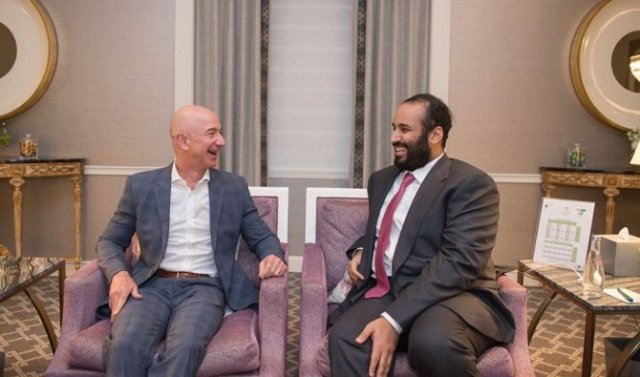
Saudi Arabia’s Crown Prince Mohammad bin Salman (MbS) was the toast of boardrooms and newsrooms alike in his recent visit to the United States. Billionaires Jeff Bezos and Bill Gates were happy to stooge for the monarch in candid, jolly photo ops.

1144486-1858336357
Billionaire Jeff Bezos with MbS (Saudi Press Agency)

Those photos are a perfect representation of the US-Saudi relationship when it comes to Yemen – billionaires cheerfully posing for professional photos while thousands starve.

Senators Bernie Sanders and Mike Lee recently sponsored a bill that would have ended US involvement in the brutal, Saudi-led and US supported imperialist war in Yemen but the legislation didn’t even come up for a vote. Ten Democrats, including recently elected Alabama #resistance hero Doug Jones, flocked to the side of their Republican colleagues to table the bill.

While US lawmakers continue to “resist” the Trump administration through acquiescence, Yemenis – already some of the world’s most impoverished, food insecure people – face US bombs dropped by Saudi pilots, Houthi ordnance, cholera, famine and mass death.   

Who is responsible for what the UN now calls the world’s worst humanitarian crisis?

Continue reading “Disaster by Design”

Make Aggression a Crime Again

By Michael Youhana

Last week, Sinan Antoon published a reflection on the fifteenth anniversary of the invasion of Iraq in The New York Times. An emergent antiwar left would do well to contemplate his essay in its entirety. One line, in particular, struck me:

“The invasion of Iraq is often spoken of in the United States as a ‘blunder,’ or even a ‘colossal mistake.’ It was a crime.”

Zahra Ali, Matt Taibbi, and even Jill Stein made similar statements on the solemn anniversary. Much of the American left seems to agree on this point.

But was the invasion of Iraq actually a crime? Kirk H. Sowell, a meticulous analyst of Iraq’s domestic politics, doesn’t think so. He argues that such accusations are little more than petty slogans:

“The use of the term “crime” is mindless. No evidence of a crime is put forward; Iraq in fact violated the armistice, which followed the 1991. And a “crime” requires a mental state. Bush’s ignorance was historic, but the evidence is clear he sincerely believed the WMD rhetoric.”

I disagree with Sowell. While I don’t think that there’s anything wrong with sloganeering for a good cause, doing so is not necessary here. The Iraq War was a crime. And the war was criminal whether or not President Bush was genuinely concerned about the proliferation of weapons of mass destruction. It was criminal for the simple reason that the war’s architects violated the well-established international prohibition against waging a war of aggression.

Continue reading “Make Aggression a Crime Again”

Fifteen Years of Blood

This week is the fifteenth anniversary of the beginning of the Iraq War, an illegal intervention that continues to immiserate millions. The war is a moral wrong and a criminal act, which condemned the war and its proponents long before the first munitions claimed their first victims. By the time the consequences of the war unfolded, they should have been damned irrevocably. The hideous fruits of the Iraq War – the human suffering, the interminable and metastasizing violence, the wanton squandering of wealth, corruption, outright looting, the hundreds of thousands or more Iraqi and over 4800 coalition dead before the initial 2011 withdrawal – are not the product of some unforeseen twist of fate. They fell well within the predictions and warnings of its opponents, offered openly at the time.

Yet within the conventional wisdom of the Washington national security establishment, to have aligned yourself with the most stridently anti-war voices in 2002 and 2003 remains a similar or greater discredit to your character and continued professional suitability than having planned or advocated the war itself. Too many of the policymakers who pushed for or voted for the Iraq War remain not only in office or positions of influence, but relied upon as key figures in national security legislation. Too many of the supposed experts who ginned up the Iraqi threat and bungled the war’s execution remain trusted fonts of strategic wisdom. Too many of the journalists and commentators who pushed dubious information and waged a propaganda campaign against the war’s opponents remain trusted voices in today’s debates. Until there is accountability suitable for the magnitude of the wrong, there is little chance of an authentically left policy, or any firm departure from the miserable Washington national security consensus, successfully breaking free of malign institutions and their tired dogmas.

Continue reading “Fifteen Years of Blood”

The Skripal Poisonings and the Chance To Build A Left Foreign Policy

Jeremy Corbyn, leader of the Labour Party, has been one of the prime movers in exposing the corrupting influence of foreign money and Britain’s complicity in Russian crimes. His response to Tory PM Theresa May, (and even his more measured comments today) however, shows the limits of Corbyn’s foreign policy prowess as well as the general unease left politicians still have have in dealing with the confluence of international relations and finance. Indeed by using the tools of financial sanctions against the corrupt and the dangerous, we can create a more equitable society while punishing Putin and his allies where they will feel it the most.

Theresa May announced this week that the UK would expel 23 Russian diplomats, identified as “undeclared intelligence officers” after the attempted poisoning of former Russian spy Sergei Skripal and his daughter Yulia Skripal in Salisbury. Provided after an ultimatum that drew only mocking and sarcasm from Russia’s foreign ministry, May went so far as to declare the use of the nerve agent Novichok (a weapon developed by the USSR in the 1970s and 80s) an “unlawful use of force.” Among other measures, May also announced that the UK would be increasing customs checks for private flights originating from Russia as well as a variety of other more pro forma measures. Continue reading “The Skripal Poisonings and the Chance To Build A Left Foreign Policy”